Link building – is the process of building external links to a website to strengthen its visibility in search engines. In 2026, link building works as part of off-page SEO: with competitor analysis, link source selection, anchor control, PR placements, monitoring, and risk assessment.
In short, link building is work with a website’s authority outside the website itself. Links help Google discover pages, understand relationships between documents, and evaluate relevance. The mere presence of a backlink does not guarantee ranking growth. For SEO, the topic of the linking site, context, page quality, anchor text, profile dynamics, and value for the reader all matter.
At SEO-Evolution, we treat link building for a website as part of an overall SEO strategy. Before placements, we check the technical condition of the site, landing pages, competitors, and the current backlink profile. Links strengthen pages that already have a clear structure, useful content, and potential for growth.
Link building delivers the best results as part of a comprehensive SEO strategy. Before systematic link promotion, check the technical foundation, indexation, content, and internal linking so that external links strengthen pages that are already prepared for search growth.
What is link building?
It is the process of getting external links from other websites to your resource. Such links are called backlinks or inbound links. They can point to the homepage, service pages, product categories, blog articles, case studies, or other important URLs.
In SEO, external links strengthen the authority of pages and help them compete for higher positions in search. They help search engines understand which materials in a topic are cited more often, recommended, and used as sources. That is why quality links can affect a page’s ranking, its positions in organic search, and its ability to outperform competitors for commercial and informational queries.
Links, backlinks, and inbound links
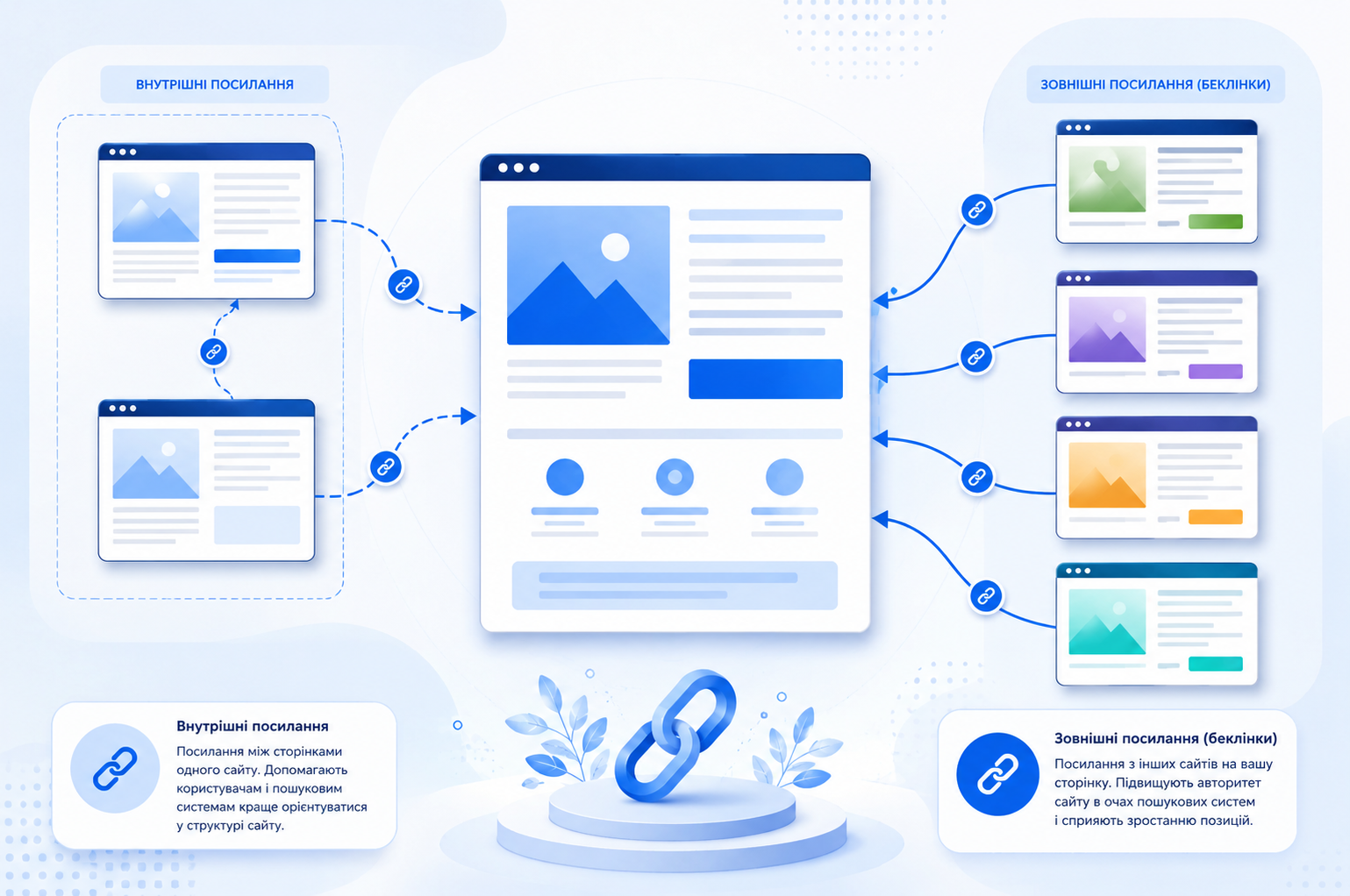
Links are hyperlinks that allow a user or search crawler to move from one page to another. Backlinks are external links from other domains to your website. Inbound links are the same concept described in a more direct SEO term.
In SEO, the main focus is usually on inbound external links: who links to the site, from which pages, with which anchors, to which URLs, and with what growth dynamics. Internal links are also important, but they belong to internal optimization and site structure.
Why link building matters for a website
Link building influences the authority of a website and its individual pages in search. When relevant resources link to a page, it receives additional external signals: topical relevance, trust, brand mentions, and confirmation of the material’s value within the niche. That is why quality links can affect a page’s ranking, its organic positions, and its ability to compete for difficult queries.
In competitive niches, many factors influence a page’s ranking in search results. The outcome depends on content relevance, technical accessibility, structure, user behavior signals, brand strength, and the backlink profile. If two pages answer the query equally well, the advantage often goes to the one cited more often by topical websites, media, directories, partners, or professional platforms.
Before building links, the page must be ready for promotion: open for indexation, clear for search engines, connected to other important pages on the website, and strong enough in terms of content. If the technical foundation is weak, external links will strengthen a page with limited potential. Read more about preparing a website for promotion in our article on technical SEO .
Types of links in SEO
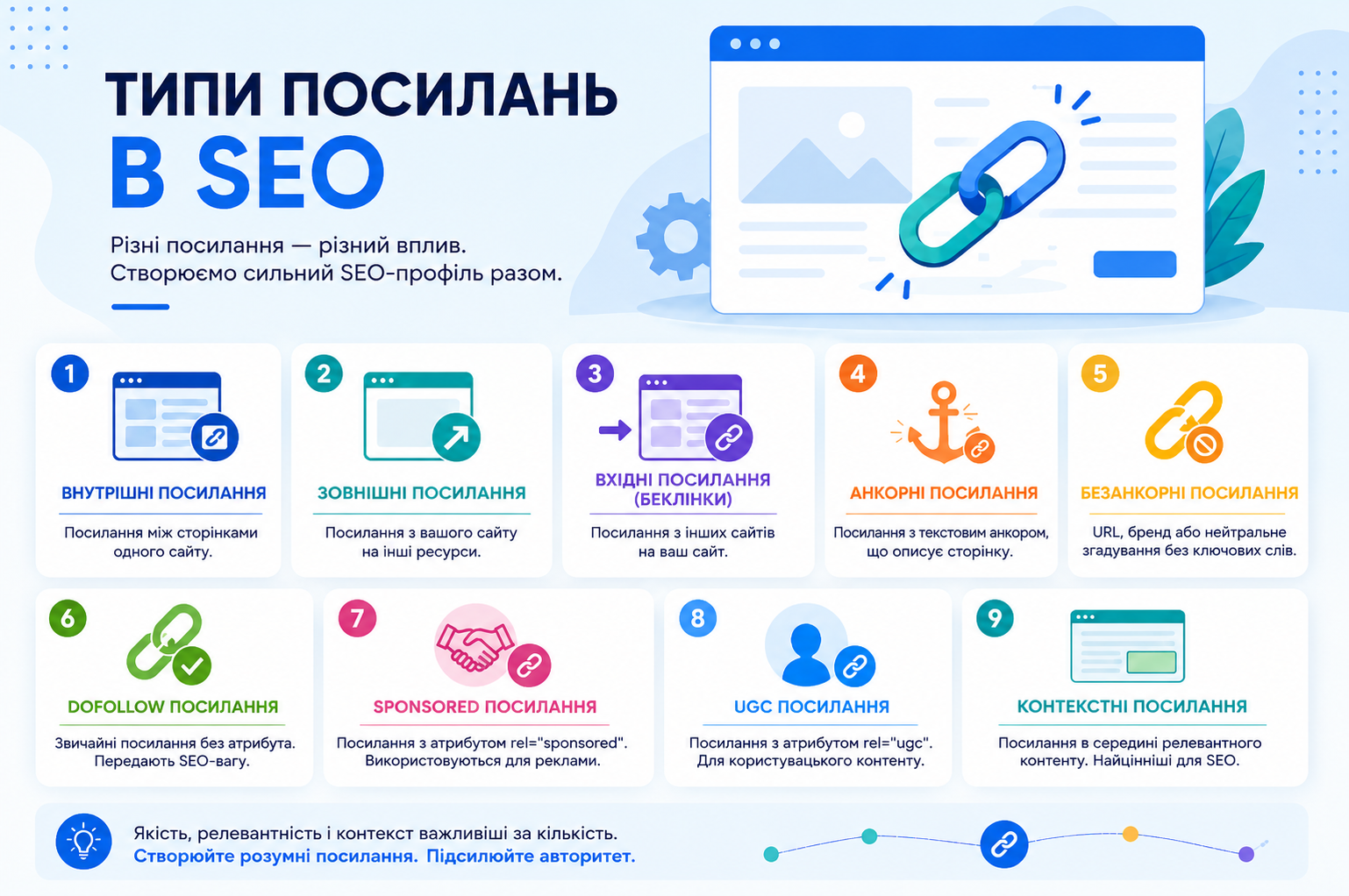
In SEO, links serve different purposes: internal links help distribute weight between pages on the same website, inbound links strengthen authority from external sources, outbound links point to sources or partner resources, while anchor and non-anchor links shape the overall backlink profile. That is why it is important to assess not only the number of links, but also their type, context, attribute, and the quality of the page where they are placed.
| Link type | What it is | When it is used |
| Internal links | Links between pages of the same website | For navigation, internal weight distribution, and better understanding of the site structure |
| External links | Links from your website to other resources | For sources, partners, official documents, studies, and useful additions to the topic |
| Inbound links | Links from other websites to your website | For off-page SEO, PR, authority, and referral traffic |
| Anchor links | Links placed under specific anchor text | When the link text naturally explains where the user will go |
| Non-anchor links | A URL, brand name, or neutral mention without a keyword phrase | For a more natural profile and lower risk of overusing commercial anchors |
| Dofollow links | A standard link without a special rel attribute | When the website’s editorial side genuinely recommends the page and does not mark it as advertising or user-generated content |
| Nofollow links | Links with the rel="nofollow" attribute |
When a website does not want to pass a full recommendation signal or does not want to fully associate itself with the resource |
| Sponsored links | Links with the rel="sponsored" attribute |
For ads, paid placements, sponsored articles, and partner materials |
| UGC links | Links with the rel="ugc" attribute |
For forums, comments, profiles, and content created by users |
| Contextual links | Links placed inside the main body text of a page | For guest posts, PR materials, expert comments, and reviews |
| Crowd links | Links from discussions, forums, Q&A platforms, and comments | For presence in discussions and referral traffic, if the link genuinely helps answer the question |
Dofollow, nofollow, sponsored, and ugc links
Dofollow links have the greatest importance for link building because they are open to passing search signals. However, the quality of such a link is determined not by the attribute itself, but by the platform, context, anchor, and the page it points to. A dofollow link from a topical resource inside a strong article can strengthen a page, while a dofollow link from a spammy site creates risk for the backlink profile.
Nofollow links are often underestimated, although they are needed in a normal strategy. They can bring visits, brand mentions, media presence, directory visibility, inclusion in topical selections, and a more natural backlink profile. If a site has only dofollow links with commercial anchors, it looks artificial.
Sponsored and ugc are used not for direct page strengthening, but for correctly marking the format of the placement. Paid materials, partner publications, and advertising integrations are marked with rel="sponsored" . Links from forums, comments, and user-generated content are marked with rel="ugc" . For SEO, the goal is not to chase only dofollow links, but to build a balanced profile with different link types, anchors, and sources.
Anchor and non-anchor links
An anchor link is a link placed under a specific piece of text. For example, if the phrase SEO website promotion points to a service page, that phrase is the anchor. For search engines, anchor text helps understand which topic the linked page is associated with.
A non-anchor link is a link without a keyword phrase in the text. Most often, this is a page URL, brand name, company name, or neutral wording. Such links do not provide an exact keyword signal, but they make the backlink profile more natural and help avoid overuse of commercial anchors.
In link building, the balance between anchor and non-anchor links matters. If most external links use the same keyword phrases, the profile looks artificial. A normal strategy includes brand names, URLs, page names, mixed anchors, topical phrases, and only a limited share of exact commercial keywords.
An SEO anchor list is formed after analyzing competitors, the current backlink profile, and the pages that need strengthening. For a young website, it is usually safer to start with brand mentions, non-anchor links, and topical placements. Exact commercial anchors should be added carefully, when the site already has a basic level of trust and natural link growth dynamics.
Link building methods
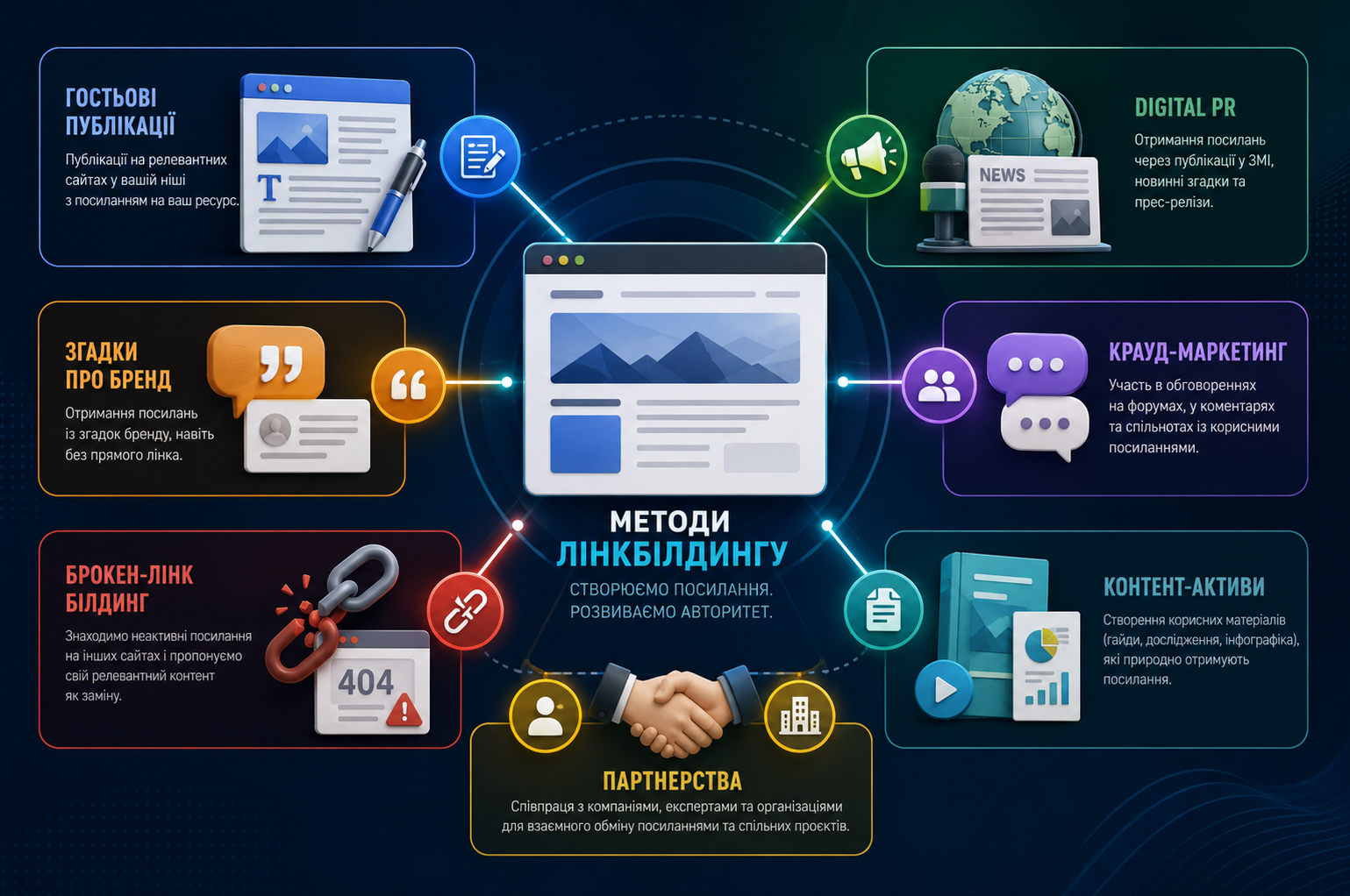
A link building method determines not only how a link is acquired, but also the level of control over the result. In some cases, an SEO specialist controls the anchor, page, platform, and placement context. In other cases, the result is a brand mention, a referral visit from an article, or a natural link without precise control over wording.
For SEO, it is important to understand the practical difference between methods. A guest article gives a predictable placement inside topical content. Digital PR works through a newsworthy angle and can bring media mentions. Crowd marketing fits discussions and referral traffic. Directories and profiles are useful only when the platform is high quality and relevant to the business. Linkable assets give the strongest effect when there is a real reason to reference them.
| Method | When it fits | What it gives | Risk |
| Guest posting | There is expert content and relevant topical platforms | Contextual links, reach, authority | Moderate: depends on the quality of linking sites, anchors, and placement scale |
| Editorial outreach | Direct communication with blogs, media, businesses, or partners is needed | Higher-quality link sources and a more natural context | Low or medium, depending on the approach |
| Digital PR | There are data, cases, studies, or expert comments | Brand mentions, media links, trust | Low, if the material has informational value |
| Crowd marketing | There are live topical discussions where a link helps answer a question | Referral traffic, presence in discussions, natural mentions | High, if it turns into forum spam with optimized anchors |
| Broken link building | It is possible to find broken links on other websites and offer a useful replacement | A quality link through value for the website owner | Low, but the method requires time |
| Content people naturally link to | It is possible to create research, statistics, a calculator, guide, or tool | Natural links without directly asking for placement | Low, if the content is genuinely strong |
| Directories and business listings | Basic visibility is needed for a local or B2B business | NAP signals, brand mentions, basic links | High, if these are low-quality directories without moderation |
| Turning brand mentions into links | The brand is already mentioned in media, blogs, or directories | Improving existing mentions without creating new content | Low |
Where to get links for a website
Link sources should be selected by niche relevance, audience quality, the topic of the linking page, and the task of the page that needs strengthening. For an SEO agency, the most valuable sources are marketing media, industry blogs, business directories, interviews, case studies, expert comments, and partner pages. For an online store, product reviews, topical selections, comparison articles, PR publications, partner brands, and media in the product category usually work better.
Before choosing link sources, analyze target pages, the current backlink profile, and the gap with competitors. In service-based projects, we often see the same imbalance: most external links point to the homepage, while commercial landing pages remain unsupported. As a result, the domain may have overall authority, but service pages lose in search results for queries where targeted link support is needed.
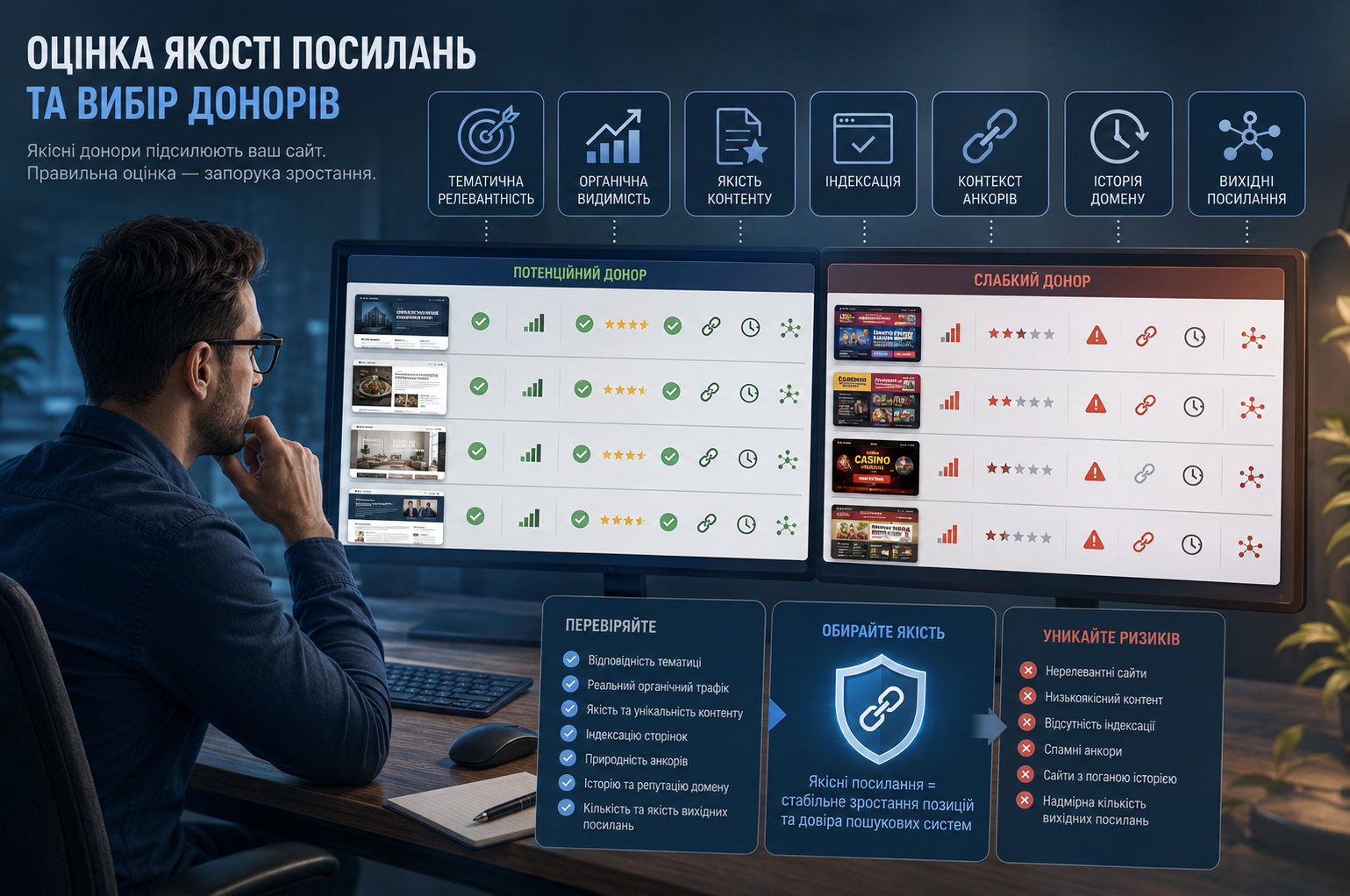
How to evaluate link quality
Link quality is assessed on three levels: the linking site, the placement page, and the link itself. Important factors include the site’s topic, organic visibility, content quality, page indexation, the number of outbound links, domain history, anchor text, and the context in which the link is placed.
At SEO-Evolution, we do not make decisions based only on SEO tool metrics. DR, DA, traffic, the number of ranking keywords, and visibility dynamics provide an initial filter, but the final assessment always includes manual review. A link source may have normal tool metrics and still be a platform for mass article sales, random topics, and commercial links.
Criteria for choosing link sources
- Topical relevance. The linking site should be connected to the niche, audience, or topic of the page that the link strengthens.
- Organic visibility. Check search traffic, keyword dynamics, and sharp drops after Google updates.
- Page quality. The material with the link should look like a full editorial or expert publication, not like a text created only for link placement.
- Outbound links. If a site regularly links to dozens of unrelated commercial domains, the value of such a source decreases.
- Indexation. The page with the link should be open for crawling, available for indexing, and actually present in search.
- Domain history. Check topic changes, signs of expired-domain reuse, participation in site networks, and abrupt changes in ownership or structure.
- Anchor and context. The link should fit the topic of the material, point to a relevant page, and avoid overusing commercial anchors.
Link building risks: link spam, paid placements, and toxic sources
Bad links for a website are links created mainly to manipulate rankings. They provide no value to the user, do not fit the context, and are often placed at scale: in low-quality directories, automated profiles, comments, footers, or random site networks.
Google classifies buying or selling links for passing ranking signals, excessive link exchanges, automated link creation, low-quality directories, mass template footer links, and forum comments with optimized anchors as link spam. Spam policies for Google web search explain which practices can create risks for website visibility.
Buying links in SEO remains a sensitive topic. A business can buy advertising, PR publications, partner materials, or reviews. The problem starts when the only purpose of the placement is to influence rankings, while the material itself has no editorial value. For paid and advertising links, use rel="sponsored" , for user-generated content use rel="ugc" , and for non-recommendation links use rel="nofollow" .
Signs of risky links
- Too many exact commercial anchors. A profile looks artificial when most links use the same keyword phrases. Rebuild the anchor list: add the brand, URL, mixed anchors, and non-anchor formats.
- Linking sites without topical relevance or traffic. If a site has no visibility, audience, or normal content, a link from it rarely provides value. Check every platform manually.
- Forum links with optimized anchors. A crowd link should look like an answer in a real discussion. If the comment is created only for the keyword phrase, it is a risk.
- A sharp jump in link volume. For a young website, it is unnatural to receive dozens of new referring domains with commercial anchors in a short period without PR, content, or brand activity.
- Paid materials without the correct attribute. For advertising and partner placements, use
rel="sponsored", and for user-generated content userel="ugc".
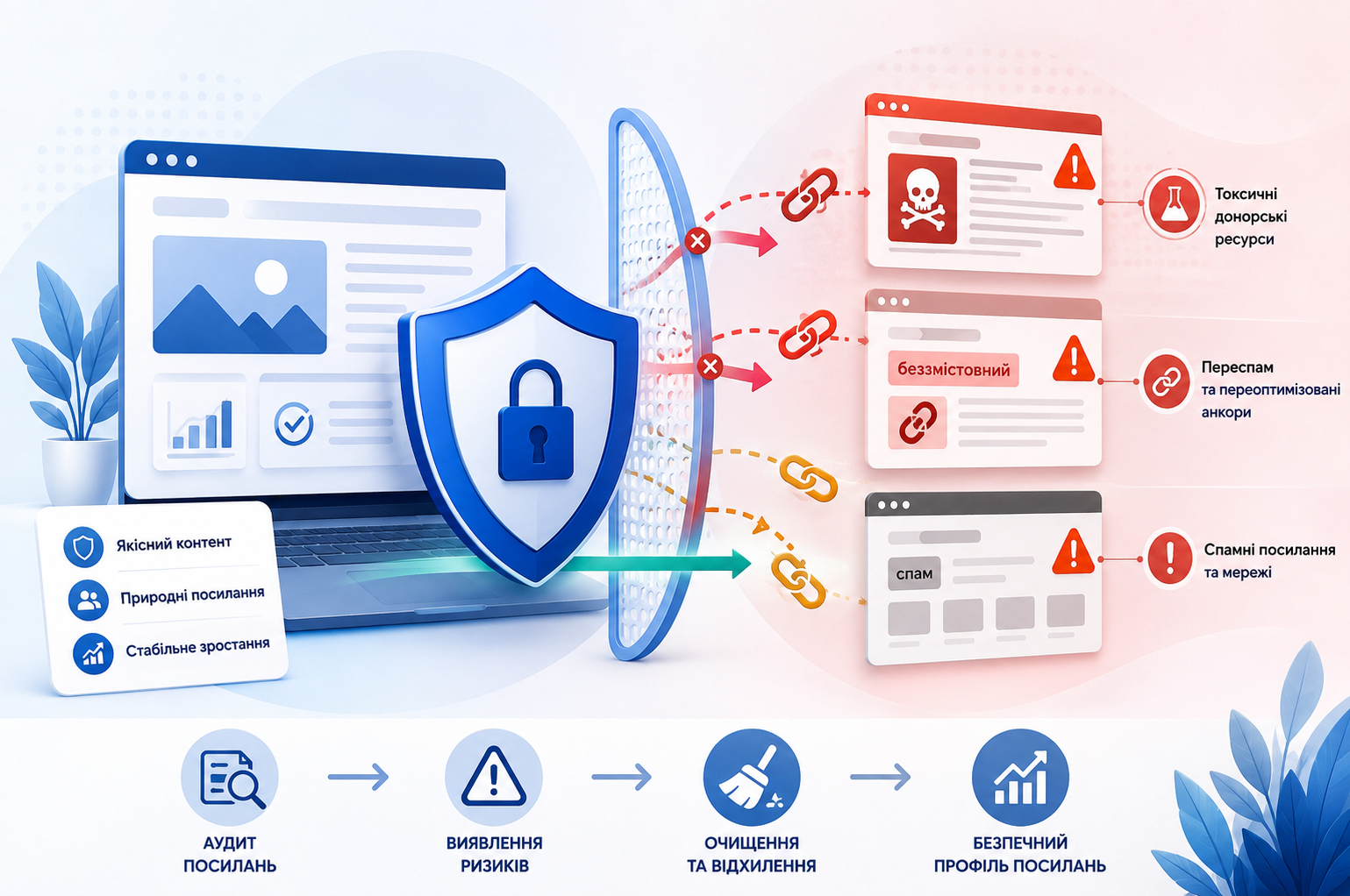
What to do with toxic links
If toxic links appear in the profile, do not remove everything indiscriminately. First, separate random noise from a systemic problem. Most websites have some weak or strange backlinks that appear without the owner’s involvement. The problem begins when there are many such links, they use the same anchors, or they come from obvious spam networks.
Collect data from Google Search Console and SEO tools, group linking domains by quality, check anchors, dynamics, and target pages. If possible, remove the riskiest links manually. Use Disavow carefully: this tool is needed for genuinely problematic situations, such as a mass spam profile, a history of link buying, or the risk of Google manual actions – restrictions applied after a manual review of a website for violating search policies.
How to build a link building strategy?
A link strategy is a system for working with external links: from selecting pages for strengthening to controlling anchors, link sources, placement pace, and results. It is built after analyzing the website, competitors, and the current backlink profile so that every placement has a clear SEO task.
Stages of link building
- Backlink profile audit. Check referring domains, link quality, anchors, growth dynamics, toxic links, attributes
dofollow,nofollow,sponsored,ugc, and the pages that already receive external support. - Competitor analysis. Study which competitor pages receive links, from which platforms, in what format, with which anchors, and how steadily their profiles grow.
- Selection of target pages. Distribute links between pages with search potential: services, categories, case studies, strong blog articles, comparisons, or materials that internally strengthen commercial pages.
- Anchor list formation. Define the share of branded, non-anchor, URL, mixed, topical, and commercial anchors in the strategy. Use competitors’ anchor profiles as a reference, but adapt them to the site’s age, niche, and current trust level.
- Selection of link sources. Choose sources by topic, organic visibility, SEO metrics, the quality of their own backlink profile, domain history, page indexation, the number of inbound and outbound links, and the editorial quality of publications.
- Content preparation. Material for external placement should have standalone value, a clear topic, logical structure, and a natural place for the link. A text written only for the anchor is weak for both SEO and brand reputation.
- Placement and verification. After publication, check whether the placement matches the technical brief: page URL, anchor, link attribute, target page, material accessibility, indexation, and absence of unwanted text changes.
- Result monitoring. After placements, track the response of target pages: position changes, organic traffic, lost links, and anchor profile dynamics.
How not to make mistakes with link growth pace
The pace of link growth depends on domain age, niche, brand activity, the current profile, and query competitiveness. For a new website, a sharp increase of dozens of domains with commercial anchors looks unnatural, especially when the brand has no search demand, media mentions, or stable content yet.
For an established website, the pace may be higher if it matches the company’s real activity. New PR materials, studies, partner publications, case studies, expert comments, and content updates explain an increase in the number of links. The backlink profile should develop together with the brand, not separately from it.
When second-tier links tier 2 are needed
Second-tier links, or tier 2, point to external pages where links to your website are already placed. For example, a guest article in a topical media outlet links to a service page, and additional materials strengthen that guest article itself.
This approach makes sense for strong placements: expert articles, PR publications, reviews, studies, or materials on authoritative topical platforms. Strengthening weak purchased pages gives no strategic value. First, a quality first tier of links is formed; after that, additional strengthening can be used for the most important external publications.
Link building for online stores, service websites, and local businesses
Link building for business should account for the type of website. For an online store, categories, product selections, brands, reviews, and informational articles matter. For a service website, commercial landing pages, expert materials, case studies, and local pages are important. For a local business, maps, directories, local media, partnerships, events, and regional mentions are relevant. Below is the practical logic for choosing pages and link sources for different types of websites.
| Website type | Where links should point | Suitable methods |
| New or young website | Homepage, basic service pages, informational materials | Brand mentions, moderated directories, partner pages, careful editorial outreach |
| Service website | Service pages, case studies, expert articles, about page | Guest posts, digital PR, expert comments, industry media |
| Online store | Product categories, brand pages, blog articles, product selections | Reviews, topical selections, PR materials, brand partnerships, linkable assets |
| Local business | Homepage, contacts, local landing pages, Google Business Profile | Local directories, regional media, partner organizations, events |
| Blog or media website | Research, guides, rankings, analytical materials | Content people naturally link to, PR, citations, selections, expert columns |
When a website already receives organic traffic but does not grow for competitive queries, external links alone are not enough. Links deliver a stronger effect when the page matches search intent precisely, has a clear structure, is indexed correctly, does not compete with internal duplicates, and is supported through internal linking. Examples of comprehensive work with such tasks are available in our portfolio .
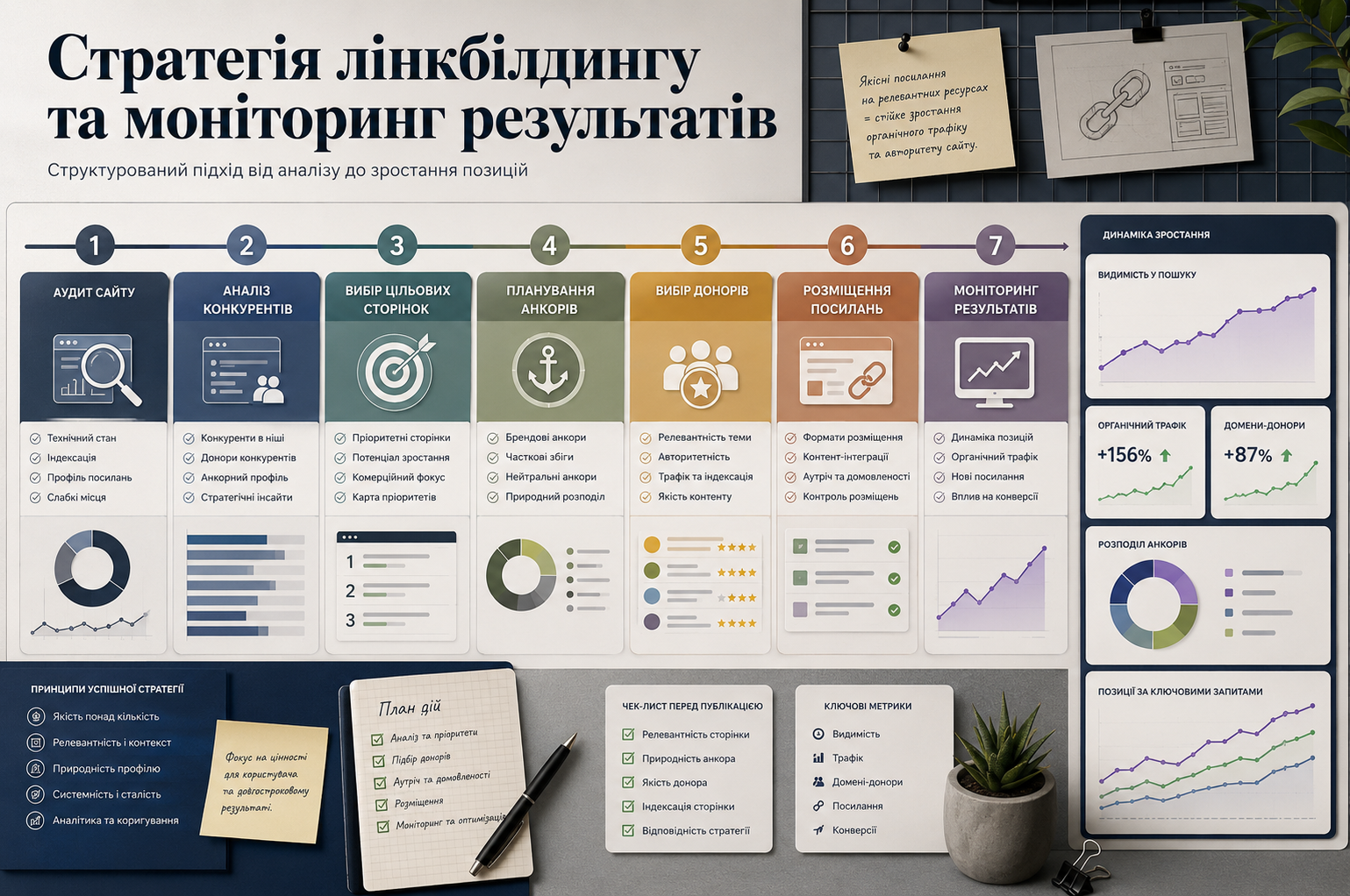
How to track link building results
Link building results are evaluated on three levels: placement quality, changes in the backlink profile, and the response of target pages in search. The fact of publication alone does not mean SEO impact. The link must remain accessible, indexed, relevant to the page, and useful for the overall promotion strategy.
What to check after placement
- accessibility of the linking page for crawling and indexation;
- placement of the link in the main content, not in technical or template blocks of the page;
- alignment of the anchor with the approved anchor strategy;
- link attribute:
dofollow,nofollow,sponsoredorugc; - indexation of the page with the placement in Google;
- link retention after publication and several weeks later;
- dynamics of referring domains and the quality of new sources;
- appearance of unusual spam links in the profile;
- changes in rankings, impressions, clicks, and traffic on pages that received external support.
For control, use SEO tools, manual placement checks, and data from Google Search Console and GA4. In GSC, you can track impression dynamics, clicks, average position, landing pages, and part of the external links. Read more about working with the tool in our practical guide to Google Search Console .
Conclusions about link building should be made after enough data has accumulated. In competitive niches, the first changes may appear after several weeks or months, so placements should be evaluated together with other factors: site updates, content changes, seasonality, Google updates, and competitor actions.
Can a website owner do link building independently?
A website owner can handle link building independently at a basic level: negotiate with partners, place company information in quality directories, provide expert comments, offer guest materials, and work with brand mentions. These actions are useful when there is an understanding of the platform’s topic, page quality, anchor text, link attribute, and the page that needs strengthening.
The main problem with independent link building appears during link source selection. A platform may look normal on the surface but have weak traffic, an artificial backlink profile, too many advertising materials, poor indexation, or a topic that does not fit the website. Links from such resources rarely bring value and can create unnecessary risk for the profile.
Another common mistake is buying links without a plan for pages and anchors. As a result, external links point mainly to the homepage, exact commercial anchors repeat, and important landing pages remain unsupported. Such link building spends the budget but does not solve the task of promoting specific queries.
Before independent placements, assess the current backlink profile of the website, review which pages competitors promote, define a safe anchor list, and check link sources before payment. Without this analysis, link building quickly turns into random link buying.
At SEO-Evolution, link building is treated as part of SEO website promotion . We evaluate not a single placement in isolation, but its role in the overall strategy: which page it strengthens, which signal it adds, how it affects the anchor profile, and whether it helps the site compete in search.
Questions about link building
How does link building work?
Link building works by creating external signals around a website. Other resources link to your pages, search engines see these connections, analyze context, link source quality, anchor text, topic, and the overall profile. If the page is high quality, technically accessible, and answers the query, external links can help it compete in search.
Which links are useful for SEO?
For SEO, useful links come from topical, indexed, active, and editorially understandable websites. A link should be appropriate within the page context, avoid spammy anchors, and not look like part of a mass scheme. A strong profile usually includes different link types: brand, URL, guest posts, PR, natural mentions, contextual links, and some nofollow and sponsored links when they make sense for the placement format.
Can links from forums be used?
Forum link building makes sense only when the link helps answer a question in a real discussion. Manual link placement on forums and in directories just for the anchor carries more risk than value. Forum comments with optimized commercial anchors belong to risky practices.
How many links are needed to promote a website?
The number of links depends on the niche, competitors, domain age, current profile, website quality, and target pages. For one project, several strong topical placements per month may be enough. For a competitive online store, a longer plan is needed with work on categories, content, PR, and brand mentions. Start with competitor analysis, not with a universal number.
Conclusion
Link building remains an important part of SEO, but mechanical growth of link mass no longer works as a stable strategy. The quality of link sources, relevance of placements, natural anchor list, balance between link types, risk control, and the connection between external links and specific website pages all matter.
A strong backlink profile is formed together with technical optimization, quality content, internal linking, analytics, and brand development. Links bring better results when they strengthen pages with a clear structure, understandable value for the user, and real potential for organic search growth.
Before starting link building, assess the current website profile, define pages for promotion, analyze competitors, prepare an anchor strategy, and check link sources before placement. This approach reduces risks and makes link work a controlled part of the SEO strategy.
If you want to build a quality backlink profile, strengthen important website pages, and improve organic search visibility, contact the SEO-Evolution team . We have been providing SEO website promotion services since 2013 and have practical experience with link building across different business niches.