




CMS is used so that after website creation the owner of the site or his subordinates, who do not have extensive experience in development, design, administration, could fill, update and promote the resource. It provides the ability to manage all data. To master it, you do not need to have significant knowledge.

CMS is convenient to use for creating new pages. They are designed according to a specific template. The administrator just needs to post the content. This allows you to avoid financial dependence on third-party organizations developing websites.
Paid, free and custom CMS
Some companies that develop websites offer clients CMS created in-house. They have the necessary functionality and are easy to use.
The main disadvantage of such developments is that they are tied to the performer. When choosing such solutions, you need to make sure that the company that created the engine will last long enough, since third-party contractors will not be able to maintain its functionality.
There are many paid and free CMS on the Internet. Most novice users think that the difference between them is the quality of implementation and security. In fact, they differ in the availability of technical support.
What you can choose:
-
free CMS. The best option for those who have enough time to search for solutions to emerging problems on forums and communities;
-
paid CMS. A client with financial resources receives comprehensive support. His problems are resolved very quickly with minimal involvement in the process.
According to statistics, most websites are created on free engines. It's convenient and cheap. The security threat to most CMSs is caused by the incompetence of users - installing unverified plugins, ignoring updates, introducing viruses to the computer and insecure passwords.
Which CMS is better?
Just a few years ago, all the leading players (CMS) were specialized. Some were better suited for blogs (like WordPress), others were better suited for online stores, landing pages and corporate websites.
Now the situation has changed. Most engines have a variety of available plugins. This allows you to implement any task. The main thing is to choose the right solution.
When evaluating a CMS, pay attention to the following factors:
-
level of support. The more plugins, forums and communities, the more stable and flexible the engine;
-
Ease of use. A graphic editor for posting content and adding cards, as well as other functionality should be clear and easy to learn;
-
storing texts in databases and caching capabilities. For each request, the server returns a page created on the fly from the database. This allows you to provide the necessary information. This approach loads the server. Individual, generated pages can be stored in a cache for fast delivery with minimal resource costs;
-
automatic CNC generation. It is better that the selected CMS is able to independently create URLs, which are a transliteration of the title of the page.
Top three
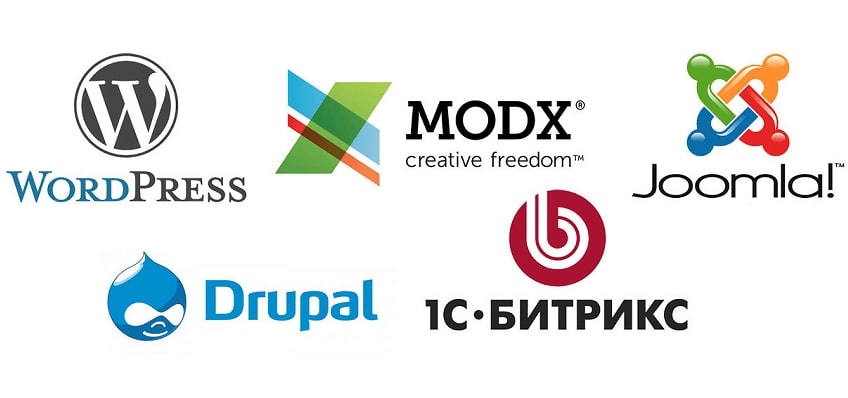
The most common CMS – WordPress . More than 40% of all checked sites work on it (data for 2023). It is designed for blogs. A wide range of extensions and plugins allows you to create forums, online stores and galleries. WordPress is a free CMS with very powerful support and ever-increasing functionality.
Second place is taken by Joomla, used to manage 30% of sites on the Internet. It has excellent support, flexibility and versatility. The threshold for mastering it is higher than that of WordPress, which is considered the easiest for beginners.
In 3rd place is 1C-Bitrix (8%). This is the most common paid engine. It is used on many large corporate websites. This CMS is fully integrated with 1C Accounting, which is of increased importance for business.
It is important to understand that with a large number of requests, all CMS written in PHP can seriously load the server. The solution is caching and writing clean code.


